When it comes to automotive seat covers, leather upholstery, and leather car seat covers, quality is everything. Automakers need reliability. Car owners want comfort and durability. Aviation clients demand safety and certification. Across these industries, Pecca Group has established itself as one of the region’s most reputable partners — known for craftsmanship, innovation, and large-scale production capabilities.
As Malaysia’s leading automotive leather upholstery manufacturer, Pecca Group has built a strong reputation over two decades for delivering superior seat covers, customised leather interior solutions, and world-class upholstery manufacturing.
Whether you’re a vehicle OEM, aviation operator, or aftermarket customer, Pecca’s capabilities and proven track record make them a preferred partner across Southeast Asia and beyond.
This article explores why Pecca Group stands out — from its technical expertise and global certifications to sustainability leadership and ambitious growth strategy.
A Proven Market Leader in Automotive Leather Upholstery
Pecca Group has long been recognised as one of Malaysia’s most established names in leather upholstery and automotive seat cover manufacturing. With facilities in both Malaysia and Indonesia, Pecca serves major national and international vehicle brands.
According to the official Group profile, Pecca engages in styling, manufacturing, distribution, and installation of leather upholstery for seat covers across the automotive and aviation industries. Their long-term customers include prominent car manufacturers across Asia, Europe, and the Middle East, reflecting their strong reliability and consistent product quality.
From compact family vehicles to high-end models, Pecca’s automotive seat covers are engineered with precision, durability, and comfort in mind.
Strong Financial Performance and Strategic Growth
Pecca’s credibility is reinforced by its solid financial track record. In FY2025, the Group reported a profit after tax (PAT) of RM57.6 million, demonstrating strong performance despite moderating automotive industry volumes. Their results were driven by enhanced production efficiency and effective cost management.
Pecca also declared a full-year dividend payout ratio of 63.3% — far above its 40% dividend policy — demonstrating financial stability and commitment to long-term shareholders.
Beyond numbers, the Group is actively strengthening its positioning. As stated by Executive Director Hugo Teoh Zi Yi, Pecca is “working towards becoming a Tier 1 supplier” — a strategic milestone reflecting customer trust and the Group’s maturing capabilities.
For customers, this means partnering with a company that is scaling, investing, and committed to excellence.
Expanded Capabilities: More Than Just Leather Seat Covers
Pecca is no longer limited to traditional automotive seat covers. As highlighted in the press release:
- Pecca now offers full interior upholstery solutions
- Their REM (Replacement Equipment Manufacturing) segment is expanding rapidly
- They are pursuing OEM contracts across Southeast Asia
- They continue to strengthen their reach across global markets including the UK, Saudi Arabia, the Netherlands, the U.S., Singapore, Australia, and more
This diversification means Pecca can support partners with:
✔ Full leather interior upgrades
✔ Complete seat cover replacements
✔ Trim and panel upholstery
✔ Custom leather solutions
✔ Aviation seat refurbishment
✔ Healthcare upholstery products
The broader the capability, the more integrated and reliable the partnership becomes.
What Should Automotive OEMs Look for in an Upholstery Manufacturer?
Choosing an automotive leather upholstery manufacturer in Malaysia involves more than comparing materials, designs and pricing. OEMs and Tier 1 suppliers need a manufacturing partner that can consistently meet specifications, maintain product traceability and support automotive safety and quality requirements.
Key areas to evaluate include:
Automotive Quality Management
Automotive manufacturing requires consistent processes across every production stage. Certifications such as IATF 16949 demonstrate that a supplier operates within an automotive-specific quality management framework covering areas such as process control, defect prevention and continuous improvement.
Pecca Leather holds IATF 16949:2016, alongside ISO 9001, ISO 14001 and ISO 45001 certifications.
Quality Control and Traceability
Quality should be managed from incoming material inspection through manufacturing, packing and final delivery.
Pecca conducts checks throughout its production process and performs internal testing on incoming automotive-grade leather. Its testing procedures include flexing endurance, tensile strength, rub fastness, abrasion and colour assessment.
Learn more about Pecca’s quality, safety and compliance.
Airbag Compatibility and Safety
Seat upholstery can interact directly with vehicle safety systems, particularly where side airbags deploy through the seat.
For applicable seat-cover designs, manufacturers therefore need controlled sewing processes and appropriate validation. Pecca states that its seat covers have undergone airbag deployment testing through organisations including Autoliv and MGA Research Corporation, including testing relating to FMVSS requirements.
Design and R&D Capability
OEM programmes may require more than manufacturing against an existing pattern. A capable supplier should also be able to support material selection, styling development, prototyping and product refinement.
Pecca’s in-house StyleLab and R&D capabilities support customised automotive interior concepts and product development for different customer and market requirements.
Explore Pecca’s design, R&D and innovation capabilities.
Manufacturing Reliability
OEM programmes require suppliers that can maintain consistent output while working to defined specifications and delivery requirements.
Manufacturers should therefore evaluate a potential partner’s equipment, process controls, automotive experience and ability to support ongoing production rather than considering the finished upholstery alone.
Pecca has more than 23 years of automotive upholstery experience and has invested in specialised cutting, sewing, embossing and perforation equipment sourced from established international machinery manufacturers.
High Manufacturing Standards & Tier-1 Ambition
What sets Pecca apart is its commitment to becoming a Tier-1 supplier — a category reserved for manufacturers who supply directly to major OEMs.
The press release highlights that Pecca is enhancing capabilities through automation, diversification, and meaningful collaborations with industry leaders, positioning them for Tier-1 readiness.
For automakers and aviation clients, this means:
- High-volume production capacity
- Consistent quality assurance
- Precision stitching and craftsmanship
- Efficient turnaround times
- Strong supply chain management
Partnering with Pecca means working with a supplier who continuously invests in manufacturing excellence.
How Is Automotive Leather Upholstery Manufactured?
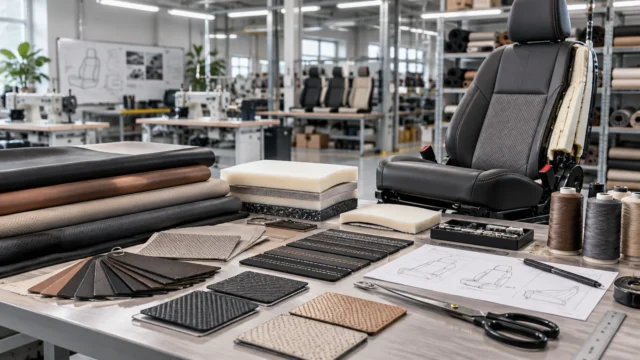
Automotive upholstery manufacturing involves several coordinated stages. Although individual processes vary depending on the vehicle model, seat design and OEM specification, a typical production workflow includes the following.
1. Design and Specification
The process begins by understanding the seat structure, vehicle model, material specification, styling requirements and applicable safety considerations.
Patterns and upholstery designs must fit the seat precisely while accommodating functional features such as headrests, adjustment controls and airbag deployment areas.
2. Material Selection
Materials are selected according to the required appearance, durability, comfort and technical specification.
Automotive upholstery may use genuine leather, leatherette, fabric or a combination of materials. Pecca works with different material types and conducts incoming inspections and laboratory testing to verify quality against required standards.
3. Precision Cutting
Approved materials are cut according to the required patterns.
Accuracy at this stage is important because inconsistencies can affect fit, sewing alignment and the appearance of the finished seat cover.
4. Sewing and Assembly
Individual material panels are sewn together to form the seat upholstery.
For seats incorporating side airbags, appropriate sewing processes become especially important. Pecca uses computerised airbag sewing equipment for relevant applications as part of its automotive safety processes.
5. Inspection and Testing
Finished products are checked against specifications before delivery.
Depending on the product and customer requirements, assessment may cover appearance, stitching, dimensions, material durability, colour consistency and safety-related performance.
6. Delivery to the Automotive Supply Chain
Completed upholstery may be supplied to an OEM, Tier 1 seat manufacturer, PDI operation or other automotive customer depending on the programme.
For its OE leather seat covers, Pecca states that it works with Tier 1 car seat manufacturers to produce covers according to car-maker specifications before the completed seat units proceed to vehicle manufacturers.
Explore Pecca’s broader automotive upholstery manufacturing capabilities.
Aviation-Ready Leather Upholstery: Certified and Trusted
Pecca is also a rising force in the aviation upholstery industry. Their aviation segment revenue grew 140% year-on-year, supported by a growing list of domestic and international aviation customers.
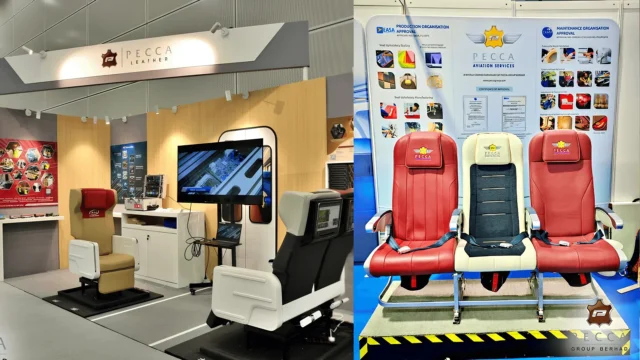
The Group holds EASA Part 21G Production Organisation Approval (EASA.21G.0075) — one of the most stringent international aviation certifications — allowing them to manufacture and supply approved aircraft seat covers. They are also certified by the Civil Aviation Authority of Malaysia (CAAM).
These certifications demonstrate:
✔ Compliance with global safety standards
✔ Capability to serve commercial airlines
✔ Approval to supply for European-registered aircraft
✔ Precision and quality suitable for aviation environments
Many automotive upholstery providers cannot meet aviation-level requirements — this is where Pecca stands apart.
Commitment to Sustainability and Eco-Responsible Manufacturing
Sustainability is becoming a key decision factor for automakers and consumers. Pecca highlights several sustainability initiatives aligned with ESG principles, including:
- Waste reduction through recycling of leather and synthetic materials
- Energy-saving measures in production
- Sustainable sourcing and traceability where possible
- Community engagement programs
Pecca Group’s sustainability framework demonstrates dedication to responsible manufacturing practices — an increasingly important value for global partners and eco-conscious vehicle owners.
A Trusted Partner for Automotive OEMs and Aftermarket Brands
Pecca already collaborates with many established car manufacturers. Their strong history serving OEMs shows they can deliver:
- Uniform and consistent output
- High-volume production
- On-time delivery
- Custom design capabilities based on OEM specifications
- Durability tested against rigorous automotive standards
Working with Pecca means working with a supplier that understands automotive industry expectations — from stitching accuracy to leather grain consistency.
OEM, PDI and REM Automotive Upholstery: What Is the Difference?
An automotive upholstery manufacturer’s requirements can vary significantly depending on where the product enters the vehicle supply chain.
Pecca serves Original Equipment Manufacturer (OEM), Pre-delivery Inspection (PDI) and Replacement Equipment Manufacturer (REM) market segments.
| Market | What It Means | Typical Requirement |
|---|---|---|
| OEM | Upholstery supplied as part of the vehicle manufacturer’s production programme | Precise specifications, consistent production, quality control and automotive compliance |
| PDI | Upholstery or interior upgrades installed before a new vehicle is delivered to the customer | Model compatibility, efficient installation and consistent finish |
| REM | Replacement or upgraded upholstery supplied after the vehicle enters the market | Customisation, fitment, material choice and installation flexibility |
For buyers, understanding these distinctions is important because the appropriate manufacturing process, design requirements, production volume and quality controls may differ between each segment.
A supplier experienced across multiple segments can also better understand how product requirements change from factory production to vehicle customisation and replacement applications.
State-of-the-Art Facilities and Regional Expansion
Pecca operates advanced production facilities in Malaysia and Indonesia, giving them the advantage of:
- Lower manufacturing lead time
- Greater scalability
- Larger production capacity
- Access to skilled labour
- Strong regional logistics networks
Their Indonesian expansion (PT Pecca Gemilang Indonesia) strengthens their competitive position and opens doors to additional OEM and regional automotive markets.
Craftsmanship Meets Innovation: What Makes Pecca’s Products Stand Out
Whether producing automotive seat covers or leather car seat covers, Pecca’s products reflect:
- High-quality stitching
- Durable material selection
- Ergonomic comfort
- Precision fit for specific vehicle models
- Refined aesthetics
Their integration of automation with skilled craftsmanship ensures each product consistently meets customer expectations.
Future-Ready Vision for the Automotive & Aviation Industry
Pecca’s long-term strategy stands on four pillars:
✔ OEM (Original Equipment Manufacturing)
✔ REM (Replacement Equipment Manufacturing)
✔ Emerging ventures
This forward-looking approach, supported by strong financial health and growing customer demand, positions Pecca as a leading upholstery supplier across multiple high-growth industries.
For partners, this means Pecca will continue to innovate, expand, and invest — ensuring long-term stability and evolving capabilities.
What Should You Ask Before Selecting an Automotive Upholstery Supplier?
Before appointing an automotive upholstery manufacturer, procurement teams should look beyond the initial quotation.
Consider asking:
- Does the manufacturer hold IATF 16949 or other relevant automotive certifications?
- What quality-control procedures are used from incoming materials to final inspection?
- How are materials tested for abrasion, strength, colour consistency and durability?
- How does the manufacturer manage upholstery around side-airbag systems?
- Can the supplier support customised designs and vehicle-specific specifications?
- What R&D and prototyping capabilities are available?
- Can production processes maintain consistency across repeated manufacturing batches?
- Does the supplier have experience serving OEM, PDI or REM customers?
- How are defects, design changes and customer feedback managed?
- Can the manufacturer support long-term production and supply requirements?
These questions help procurement teams assess the supplier’s technical capability, manufacturing reliability and ability to support an automotive programme over the longer term.
Final Thoughts: Why Pecca Group Is the Right Partner for Your Upholstery Needs
Looking for an Automotive Upholstery Manufacturing Partner?
Pecca Group combines more than two decades of automotive upholstery experience with design, manufacturing, testing and quality-control capabilities for different automotive market requirements.
Explore Pecca’s automotive upholstery manufacturing solutions or contact Pecca Group to discuss your OEM, PDI or automotive upholstery requirements.
➡️ Follow us on LinkedIn for more updates, insights, and industry news.