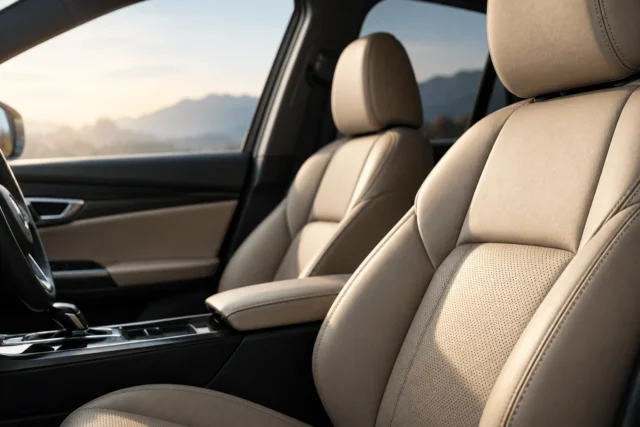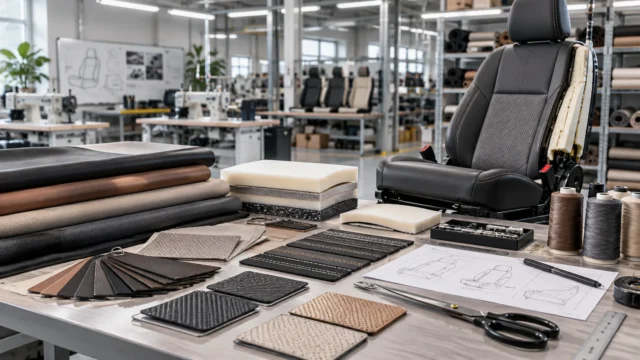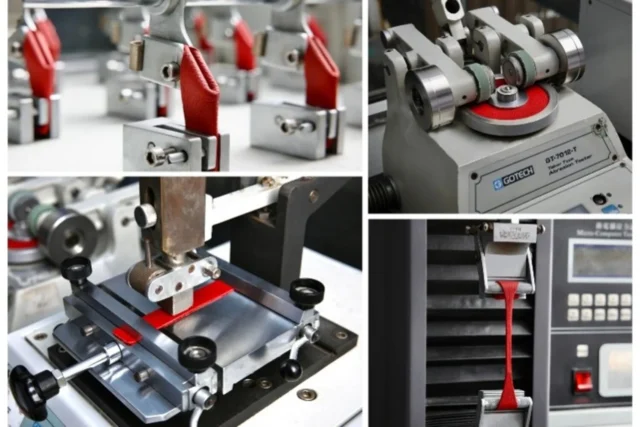
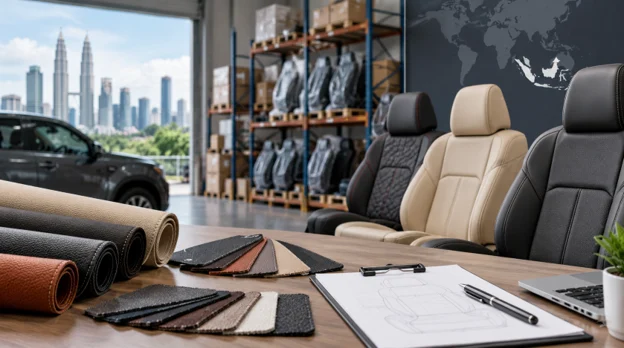
For car accessory workshops and cushion shops in Malaysia, the choice of seat cover supplier affects fitment quality, after-sales reliability, and the range of vehicles a shop can serve. The market includes locally manufactured products, import-reliant brands, and direct-to-consumer operations — each with different implications for a trade buyer.
Key Takeaways
- Material grade is a key quality differentiator: automotive-grade genuine leather and leatherette perform differently under Malaysian conditions
- Car model coverage breadth determines how much of your walk-in customer base you can serve without referrals elsewhere
- No major car seat cover supplier Malaysia wholesale publishes pricing or MOQ openly — trade terms require direct negotiation
- Airbag-safe seat cover construction is a technical requirement for modern Malaysian vehicles, not an optional feature
- A publicly listed manufacturer provides financial transparency and audited accountability not available from privately held operations
- Lead time and warranty resolution from a local car seat cover manufacturer Malaysia are generally faster than those from imported product
Why Supplier Selection Affects Workshop Reputation
In Malaysia’s car accessories market, customer experience is closely tied to the product’s fitment quality and durability. A seat cover that fails within months, or one that interferes with airbag performance, creates a warranty and reputation problem for the installing workshop — regardless of who manufactured the cover.
This makes supplier selection a quality management decision as much as a commercial one. Workshops that partner with a car seat cover Malaysia distributor with documented OEM credentials have a stronger basis for standing behind the products they install.
Five Evaluation Criteria for Trade Buyers
1. Material Specification and Consistency
“Leather” covers a wide range of materials in the Malaysian market. Understanding what a supplier actually delivers requires asking for material specifications, not just marketing descriptions:
- Automotive-grade genuine leather is graded for upholstery applications — it handles repeated flexing, temperature cycling, and sustained body contact differently from furniture or fashion leather
- Leatherette is a premium synthetic with good resistance to humidity-related cracking — relevant in Malaysia’s climate
- Standard PU leatherette is the most common and accessible tier; suitable for price-sensitive customers but with a shorter service life under tropical conditions
Suppliers who source from certified tanneries or specify automotive-grade material in their product documentation provide a more consistent quality baseline. Pecca Group distinguishes between genuine leather and leatherette grades and can provide material specification details upon request.
2. Car Model Coverage
The practical value of a supplier relationship depends on how many of your walk-in customers you can serve from their catalogue. Key questions:
- How many makes and models are supported? (Local: Proton, Perodua; Japanese: Toyota, Honda, Nissan, Mazda; Korean: Hyundai, Kia)
- Does coverage distinguish between model years when seat contours differ?
- Are variant-level differences (e.g., different trim grades with distinct seat shapes) accounted for?
Suppliers serving 40 or more supported brands typically invest in regular catalogue updates as new models enter the market.
3. Airbag-Safe Engineering
Modern vehicles sold in Malaysia — across Perodua, Proton, and Toyota ranges — integrate side airbags into the seat bolster. Seat covers that do not include engineered airbag-break seam zones or split-seam construction create a safety risk for the vehicle’s occupants and a liability risk for the installing workshop.
When evaluating any automotive seat cover OEM Malaysia supplier, ask specifically:
- Are your covers designed with airbag-safe stitching or split-seam construction?
- Which models have been verified for airbag compatibility?
- Is supporting documentation or certification available?
Suppliers with OEM manufacturing contracts for car manufacturers typically address this as a standard design requirement. Pecca Group’s leather car seat covers, for example, are engineered to the same airbag-safe construction standards required in factory assembly.
4. Manufacturing and Business Credentials
Relevant credentials for a B2B supplier evaluation:
| Credential | What It Indicates |
|---|---|
| Direct OEM contracts with car manufacturers | Product meets factory quality standards |
| Public listing on Bursa Malaysia | Audited financials; governance requirements |
| ISO or IATF quality certification | Formally audited quality management system |
| Years of continuous operation | Operational stability and manufacturing track record |
| Multi-sector manufacturing | Broader capability base |
A car seat cover manufacturer Malaysia with publicly listed accounts provides a level of financial transparency that is not available from privately held operations, which is relevant when evaluating long-term supplier reliability.
5. Trade Terms, MOQ, and Lead Time
Standard practice across Malaysian seat cover suppliers is not to publish wholesale pricing or minimum order quantities. B2B buyers negotiate these terms directly. When making initial contact, look for:
- A separate trade or dealer programme distinct from retail channels
- Defined lead times — particularly relevant for model-specific covers produced on order
- A documented warranty or replacement policy for fitment defects
Local manufacturers generally offer shorter lead times and faster warranty resolution than import-dependent suppliers. A fitment dispute resolved through a Malaysian supplier can be settled in days; the same issue with an overseas supplier may take significantly longer.
What to Assess in the Initial Conversation
When approaching a prospective car seat cover Malaysia distributor, the quality of the initial response provides useful signals:
- Can they provide a model-specific sample for your most common customer vehicle?
- Is there a dedicated trade or account representative?
- Can they reference existing workshop or dealer partners?
- Are covers supplied with installation guides and model-specific fitment notes?
Pecca Group as a Reference Point
Among automotive seat cover OEM Malaysia manufacturers, Pecca Group is notable for its OEM supply track record and public company status. The company has supplied leather seat covers directly to Toyota Malaysia, Proton, and Perodua as part of vehicle assembly, and has been listed on Bursa Malaysia’s Main Board since 2016.
Their product range — documented on the Pecca Leather automotive division page — includes OEM-spec genuine leather and leatherette options, each precision-patterned per model and year and engineered with airbag-safe construction. For workshops comparing suppliers with documented OEM credentials against those without, Pecca Group provides a useful reference point for what factory-standard requirements look like in a local manufacturer.
For trade terms and model coverage details, contact the Pecca Leather automotive division team directly.
Pecca Group is listed on Bursa Malaysia’s Main Board and manufactures automotive leather seat covers for both OEM assembly and the aftermarket segment across Malaysia and the broader region.