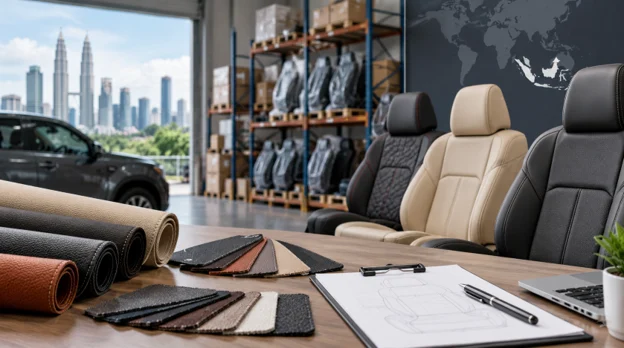
Choosing an OEM seat supplier in Malaysia involves much more than finding a manufacturer that can produce an attractive seat cover.
Automotive OEM programmes require consistency, safety, traceability, material performance and the ability to manufacture according to precise specifications. When the requirement involves seat upholstery rather than a complete seat assembly, manufacturers must also understand how upholstery integrates with seat structures, airbags, sensors and the wider vehicle interior.
For automotive manufacturers and Tier 1 suppliers, these factors make selecting the right OEM automotive upholstery supplier in Malaysia an important procurement decision.
Here is what buyers should evaluate before appointing a manufacturing partner.
Key Takeaways
- An OEM automotive upholstery supplier manufactures seat covers and related upholstery according to vehicle and customer specifications.
- OEM requirements differ significantly from general aftermarket seat-cover production.
- IATF 16949, quality control, material testing, airbag compatibility and traceability are important areas to assess.
- Strong design and R&D capabilities can help manufacturers support new vehicle programmes and customised interior requirements.
- Buyers should evaluate the supplier’s entire manufacturing system rather than focusing only on the finished upholstery.
What Does an OEM Automotive Upholstery Supplier Do?
An OEM automotive upholstery supplier specialises in producing upholstery components that become part of a vehicle’s original or factory-approved interior.
Depending on the programme, its responsibilities can include:
- automotive seat-cover design;
- material selection;
- pattern development;
- leather or synthetic material cutting;
- sewing and assembly;
- airbag-related sewing processes;
- quality inspection;
- material testing; and
- delivery to OEM or Tier 1 manufacturing operations.
The distinction is important when searching for an OEM seat supplier in Malaysia.
Some suppliers manufacture complete automotive seat assemblies, while others specialise in the upholstery fitted around the seat structure. Pecca’s automotive business focuses on styling, manufacturing, distribution and installation of upholstery for seat covers across OEM, PDI and REM markets.
Understanding the required scope early helps procurement teams identify the right type of manufacturing partner.
OEM Seat Upholstery vs Aftermarket Seat Covers
Although both products cover automotive seats, OEM upholstery and general aftermarket seat covers serve different requirements.
| Area | OEM Seat Upholstery | Aftermarket Seat Covers |
|---|---|---|
| Production basis | Vehicle or customer specification | Consumer or replacement requirements |
| Fit | Designed for specific seat configurations | May range from universal to model-specific |
| Quality requirements | Defined by OEM programme | Depends on manufacturer and product |
| Safety integration | Must account for relevant seat systems | Compatibility varies by design |
| Production consistency | Critical across manufacturing batches | Generally lower-volume or consumer-focused |
| Traceability | Often required throughout production | Varies by supplier |
For an OEM programme, appearance is only one consideration. The upholstery must also consistently meet technical, manufacturing and safety requirements.
Pecca operates across OEM, Pre-delivery Inspection and Replacement Equipment Manufacturer markets, giving it experience across different automotive upholstery applications.
How Does OEM Automotive Upholstery Production Work?
The exact manufacturing process varies by vehicle programme, but several stages are common.
1. Product Design and Specification
Production starts with the vehicle’s seat geometry, material specification, styling requirements and applicable technical requirements.
The upholstery must accommodate features such as:
- headrests;
- bolsters;
- adjustment controls;
- seat sensors; and
- side-airbag deployment areas.
Accurate specifications at this stage reduce the risk of fitment or production issues later.
2. Material Selection and Testing
The selected upholstery material must provide the required combination of appearance, comfort and durability.
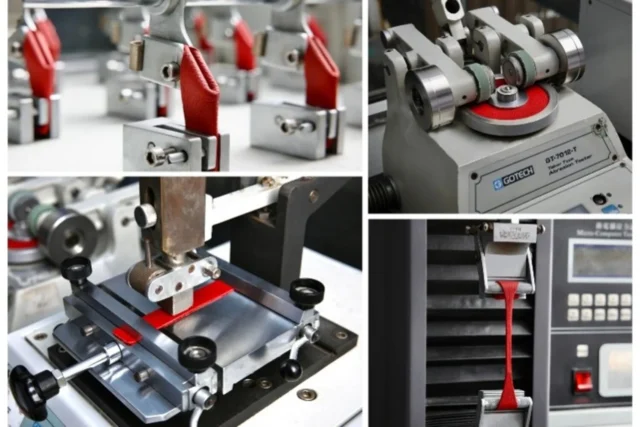
Depending on customer requirements, manufacturers may assess properties such as:
- abrasion resistance;
- tensile strength;
- flexing endurance;
- colour consistency; and
- rub fastness.
Pecca carries out inspections throughout production and documents testing procedures covering these areas for incoming automotive leather and leatherette.
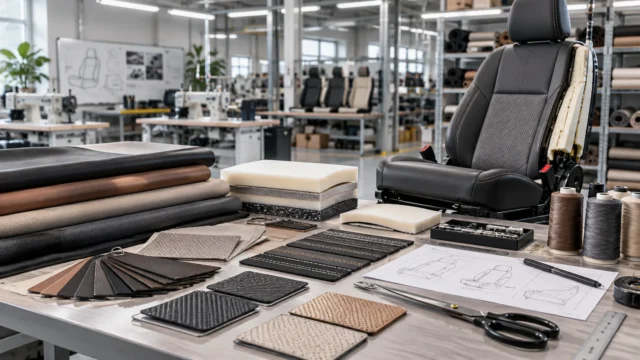
3. Cutting and Sewing
Approved material is cut according to vehicle-specific patterns before individual panels are sewn together.
Precision matters because relatively small inconsistencies in cutting or stitching can affect fit, alignment and the finished appearance of the seat.
Where side airbags are incorporated into the seat, specialised manufacturing controls may also be necessary.
4. Quality Inspection
Finished upholstery is checked against the required specification before progressing through the supply chain.
Quality controls may cover:
- dimensions;
- stitching;
- appearance;
- fit;
- material consistency; and
- safety-related requirements.
For OEM buyers, the important consideration is whether these controls are consistently embedded throughout production rather than applied only to the final product.
Why Airbag Compatibility Matters
Modern automotive seats can form part of the vehicle’s safety system.
Where a side airbag deploys through the seat upholstery, incorrect materials, seams or stitching could interfere with deployment. An OEM upholstery supplier therefore needs processes designed around the relevant vehicle and safety requirements.
Pecca states that its car seat covers have undergone airbag deployment testing by Autoliv and MGA Research Corporation. It also uses computerised airbag sewing machines for relevant applications and reports testing associated with FMVSS requirements.
For procurement teams, useful questions include:
- Has the upholstery design been validated for the intended seat?
- How are airbag seams controlled during production?
- What testing documentation is available?
- How are production changes managed after validation?
Learn more about Pecca’s quality, safety and compliance.
Why IATF 16949 Matters When Selecting an OEM Supplier
Quality management is another important differentiator between general upholstery production and OEM automotive manufacturing.
IATF 16949 is an automotive-sector quality management standard designed around areas such as defect prevention, process consistency and supply-chain quality.
For buyers, certification provides evidence that a manufacturer operates within a recognised automotive quality-management framework. It does not replace project-specific due diligence, but it can form an important part of supplier qualification.
Pecca Leather lists IATF 16949:2016, together with ISO 9001:2015, ISO 14001:2015 and ISO 45001:2018 among its certifications.
You can also read Pecca’s guide to IATF 16949 certification for automotive interior manufacturers for additional context.
Look Beyond Production Capacity: Assess Design and R&D
An OEM upholstery manufacturer should ideally contribute more than production capacity.
New vehicle programmes may require:
- customised styling;
- material combinations;
- colour and texture development;
- prototypes;
- new stitching patterns; and
- adaptation to changing consumer preferences.
An in-house design and R&D team can help bridge the gap between a concept and a manufacturable product.
Pecca’s StyleLab provides styling proposals tailored to customer preferences and target segments, supported by an in-house design team and R&D activities.
Explore its design, R&D and innovation capabilities.
Manufacturing Consistency and Traceability Matter at Scale
A sample can look excellent. The greater challenge is producing the same result consistently across hundreds or thousands of units.
OEM procurement teams should therefore examine how a supplier controls:
Incoming materials
Are materials checked against approved specifications?
Production processes
Are cutting, sewing and assembly procedures standardised?
Inspection
At what stages are quality checks performed?
Non-conformance
How are defects identified, recorded and corrected?
Traceability
Can relevant materials and production information be traced when an issue occurs?
Change management
How are changes in materials, patterns or specifications controlled?
Pecca states that inspections are performed from material selection and manufacturing through packing and pre-delivery, indicating a multi-stage approach to production quality control.
Questions to Ask an OEM Automotive Upholstery Supplier
Before selecting an OEM automotive upholstery supplier in Malaysia, procurement and engineering teams should ask:
- Which automotive market segments do you currently support?
- Do you hold IATF 16949 certification?
- What automotive upholstery materials can you manufacture with?
- What material testing is performed internally?
- How do you manage side-airbag-compatible upholstery?
- Can you support vehicle-specific pattern and design development?
- What prototyping and R&D support is available?
- How is quality controlled throughout production?
- How do you maintain consistency across production batches?
- What traceability systems are used?
- Can you accommodate customer-specific technical specifications?
- How are engineering or specification changes managed during an ongoing programme?
These questions provide a much clearer view of whether a supplier can support a long-term automotive programme rather than simply manufacture a finished cover.
How Pecca Supports OEM Automotive Upholstery Requirements
Pecca Group has more than 23 years of experience in automotive seat upholstery and specialises in designing, manufacturing, distributing and installing upholstery for seat covers. Its automotive operations serve OEM, PDI and REM markets and also supply leather cut pieces to the OEM segment.
Its capabilities include:
- automotive upholstery manufacturing;
- genuine and synthetic upholstery materials;
- in-house design and styling;
- R&D;
- material and durability testing;
- airbag-related safety processes;
- OEM, PDI and REM applications; and
- IATF 16949-certified quality management.
Pecca has also invested in specialised manufacturing machinery sourced from the United States, Germany and Italy for its automotive upholstery operations.
For buyers evaluating an OEM seat supplier in Malaysia, the key is to match the supplier’s actual manufacturing scope with the requirements of the vehicle programme. Where the requirement concerns automotive seat covers and upholstery rather than complete seat assemblies, Pecca’s capabilities are directly relevant.
Discuss Your OEM Upholstery Requirements
Selecting the right automotive upholstery manufacturer requires balancing design, quality, safety, manufacturing consistency and long-term supply capability.
A supplier should not only be able to produce an attractive seat cover, but also demonstrate how it controls the processes behind that finished product.
If you are sourcing an OEM automotive upholstery partner, explore Pecca Group’s automotive manufacturing capabilities and Pecca Leather solutions.
Have an upcoming OEM automotive upholstery requirement? Contact Pecca Group to discuss your vehicle programme, technical specifications and manufacturing needs.