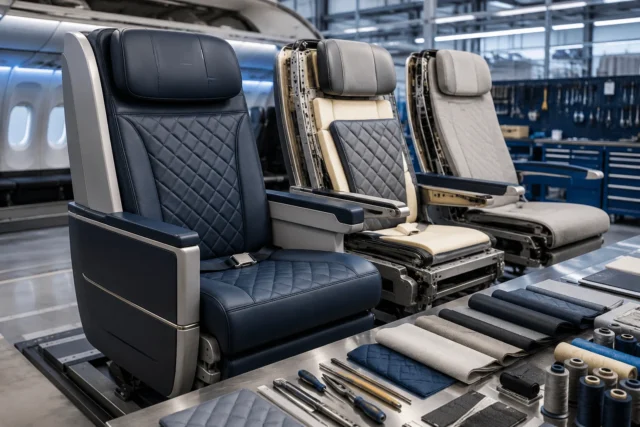
Aircraft seats experience constant passenger use, cleaning, abrasion and handling throughout their service life. Over time, seat covers can become worn, damaged, stained or inconsistent with updated cabin branding.
Replacing an entire seat assembly is not always necessary when the underlying approved seat configuration remains suitable. In the right circumstances, aviation seat refurbishment services can restore cabin appearance by replacing or refurbishing approved interior components while retaining serviceable parts of the existing installation.
However, aircraft refurbishment is not simply an upholstery exercise. Materials, manufacturing processes, approved maintenance data, traceability and applicable aviation approvals all need to be considered.
For airlines, aircraft operators and MRO providers, understanding those requirements is critical before deciding how a refurbishment project should proceed.
Key Takeaways
- Aviation seat refurbishment can address seat dress covers, headrest covers, armrest covers and other cabin interior materials, depending on the approved scope of the provider.
- The decision to refurbish or replace should consider the condition of the existing seat, approved maintenance data, project scope, material availability and maintenance schedule.
- Replacement upholstery must not be chosen purely on appearance; flammability and other applicable certification requirements need to be addressed.
- Airlines should verify exactly what an MRO or production organisation is approved to manufacture, repair or maintain.
- Documentation and traceability are as important as workmanship when aviation interior components are returned to service.
What Is Aviation Seat Refurbishment?
Aviation seat refurbishment involves renewing applicable parts of an existing aircraft seat installation rather than automatically replacing the complete seat assembly.
Depending on the approved project scope, this may include work on:
- seat dress covers;
- headrest covers;
- armrest covers;
- leather or fabric upholstery;
- plastic cabin-interior components;
- fibreglass components; and
- related decorative interior materials.
Pecca Aviation describes its own services as covering manufacturing, replacement, repair, refurbishment and installation of leather, fabric, plastic and fibreglass products for aircraft interiors. Its EASA Part 21 Subpart G approval specifically covers wrapping, cutting and sewing leather or fabric for aircraft seat dress covers, headrest covers and armrest covers.
This distinction matters.
A company approved to manufacture or maintain aircraft seat covers should not automatically be assumed to hold approval for every structural or mechanical component of the complete seat assembly. Scope should always be checked against the organisation’s applicable approvals and capability.
When Should Aircraft Seats Be Refurbished Rather Than Replaced?
There is no single rule that applies to every aircraft or seat programme.
The decision should start with the condition and approved configuration of the existing seat.
Refurbishment may be considered when:
- upholstery is worn, scratched, faded or damaged;
- the airline wants to refresh cabin colours or branding;
- seat covers require scheduled replacement;
- selected cabin-interior materials need repair;
- serviceable seat components can remain in use; or
- refurbishment can be integrated into an existing maintenance programme.
Full replacement may need to be considered where the required work extends beyond the refurbishment provider’s approved capability, where the seat no longer meets the operator’s technical requirements, or where the applicable maintenance or design data calls for replacement.
The important question is not simply:
“Is refurbishment cheaper than replacement?”
A better question is:
“Can the required work be completed within the applicable approved data, certification scope and operational requirements?”
That should be established before commercial comparisons are made.
What Parts of an Aircraft Seat Can Be Refurbished?
The answer depends on the seat design, component condition, maintenance data and provider’s approved scope.
For upholstery-focused refurbishment, commonly relevant items may include:
Seat Dress Covers
The visible upholstery covering the passenger seat is often one of the first cabin elements to show wear.
Replacement covers may be manufactured from approved leather or fabric according to the required design and production data.
Headrest Covers
Headrest areas experience frequent passenger contact and may require replacement for appearance, hygiene or condition reasons.
Armrest Covers and Trim
Leather or fabric armrest coverings may form part of a coordinated interior refurbishment project.
Other Cabin Interior Materials
Depending on the provider’s capability, the wider project may include associated leather, fabric, plastic or fibreglass interior products.
Pecca Aviation also lists distribution and installation of aircraft leather products including side-wall panels, ceiling panels and leather trim, allowing seat refurbishment to form part of a broader cabin-interior project.
For mechanical or structural seat components, operators should separately confirm whether the proposed work falls within the provider’s approved maintenance capability and the applicable aircraft or component maintenance data.
How Does the Aircraft Seat Refurbishment Process Work?
A well-controlled project should begin with technical scope, not material selection.
A typical upholstery-focused workflow may involve the following stages.
1. Define the Aircraft and Seat Configuration
The provider needs accurate information about the aircraft, seat type and required work.
This helps establish:
- what components are involved;
- applicable design or maintenance data;
- material requirements;
- quantity;
- installation requirements; and
- whether the requested work falls within the organisation’s approved capability.
2. Inspect the Existing Condition
The existing seat covers and relevant cabin components are inspected to establish what needs replacement, repair or further assessment.
The objective is to define the refurbishment scope before production begins.
3. Confirm Approved Materials and Specifications
Material selection cannot be based only on colour, texture and passenger comfort.
The selected material needs to comply with the relevant approved specification and applicable aviation requirements.
Where production is performed under EASA Part 21 Subpart G, the production organisation operates against applicable controlled design data. EASA describes Subpart G as covering organisations producing products, parts and appliances in conformity with applicable design data.
4. Manufacture or Refurbish the Interior Component
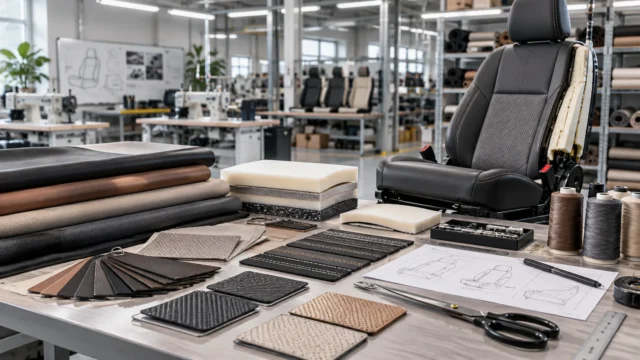
Approved leather or fabric may then be cut, wrapped and sewn according to the required specifications.
Pecca Aviation’s EASA production approval covers these activities for aircraft seat dress covers, headrest covers and armrest covers.
5. Inspection and Documentation
Completed components need appropriate quality control and records.
For airlines and MROs, the important deliverable is therefore not simply a visually acceptable seat cover. The associated production or maintenance documentation must also support the component’s use within the applicable approved system.
6. Installation or Return to the Maintenance Process
Installation and return-to-service activities must follow the applicable maintenance arrangements, approved data and authorised release process for the project.
This is why airlines should establish responsibilities between the operator, MRO, production organisation and other parties before the refurbishment programme begins.
Why Flammability Requirements Matter
One of the biggest differences between automotive upholstery and aircraft upholstery is the regulatory environment surrounding cabin materials.
Aircraft cabin materials are subject to aviation fire-safety requirements.
For example, FAA guidance relating to transport-category aircraft specifically addresses flammability requirements for aircraft seat cushions under FAR 25.853 and Appendix F to Part 25.
For a refurbishment project, this means an airline should not substitute a leather, fabric, foam or other material simply because it looks similar to the original.
The project team needs to determine:
- what approved material specification applies;
- whether a proposed substitution is permitted;
- what flammability evidence is required;
- whether additional approval is necessary; and
- what supporting documentation must be retained.
“Aviation-grade” should therefore mean more than premium quality.
For procurement teams, what matters is whether the material and its use are supported by the applicable certification and technical documentation.
EASA Part 21 and CAAM Part 145: What Is the Difference?
This is particularly important for airline procurement teams because the two approvals address different functions.
EASA Part 21 Subpart G — Production
Part 21 Subpart G relates to Production Organisation Approval (POA).
EASA states that the approval establishes requirements for production organisations demonstrating conformity of products, parts and appliances with applicable design data.
Pecca Aviation’s published EASA approval is:
EASA Part 21 Subpart G
Approval No. EASA.21G.0075
Its published scope includes wrapping, cutting and sewing leather or fabric for:
- aircraft seat dress covers;
- headrest covers; and
- armrest covers.
CAAM Part 145 — Maintenance
CAAM Part 145 relates to approved maintenance organisations. CAAM documentation requires an approved organisation to use applicable current maintenance data when performing maintenance within its approved ratings and capability.
Pecca Aviation states that it holds:
CAAM Part 145 Maintenance Organisation Approval
Approval No. AMO/2017/12
Why this distinction matters
For an airline or MRO, asking only:
“Are you aviation certified?”
is not enough.
Ask instead:
“What does your approval specifically authorise you to manufacture or maintain?”
The approval scope and limitations need to match the work being commissioned.
Why Traceability Matters in Aircraft Interior Refurbishment
Aircraft refurbishment involves more than proving that the finished product looks correct.
Operators may also need to establish where materials came from, which specification was used, how the component was produced and what documentation supports the work.
Useful records can therefore include, as applicable:
- component or seat identification;
- approved technical data;
- material identification;
- production records;
- inspection records;
- release documentation; and
- maintenance records.
Exact documentation depends on the work scope and regulatory framework.
This level of traceability allows an operator or MRO to understand what was installed, under which approved process and against which technical requirements.
That becomes particularly important when managing refurbishment across multiple aircraft.
What Should Airlines Evaluate When Choosing an Aviation Seat Refurbishment Provider?
Instead of evaluating suppliers primarily on upholstery appearance or quotation price, consider the following.
| Area | What to Check |
|---|---|
| Approval scope | Does the organisation’s approval actually cover the work required? |
| Technical data | What approved design or maintenance data will the work follow? |
| Materials | Can the supplier provide materials that meet the applicable specification and fire-safety requirements? |
| Traceability | How are materials, production and maintenance activities documented? |
| Capabilities | Can the provider handle the relevant leather, fabric, plastic or fibreglass components? |
| Installation | Who is responsible for installation and authorised release? |
| Consistency | Can colour, stitching and finish be maintained across multiple aircraft? |
| Turnaround | Can production and refurbishment be coordinated with planned maintenance windows? |
These questions reveal much more about a provider’s suitability than asking for a general “aircraft seat refurbishment price”.
Project Scope and Turnaround: What Airlines Should Plan Beforehand
Turnaround cannot be accurately assessed from aircraft quantity alone.
The project schedule may also depend on:
- aircraft and seat type;
- number of seats;
- quantity of covers or components;
- existing component condition;
- material availability;
- approved design data;
- colour or branding requirements;
- sample and approval stages;
- production quantity;
- installation arrangements; and
- aircraft maintenance schedule.
This information should ideally be discussed before the quotation stage.
It allows the supplier to understand whether the project is a straightforward replacement-cover programme or a more extensive cabin-interior refurbishment.
What Information Should You Prepare Before Requesting a Quote?
Airlines and MRO providers can make initial discussions more productive by preparing as much of the following information as possible:
- aircraft type;
- seat manufacturer and seat model, where available;
- seat configuration;
- number of aircraft;
- number of seats or components;
- photographs of existing condition;
- required refurbishment scope;
- current material specification;
- desired colour and finish;
- applicable drawings or approved technical data;
- branding requirements;
- required delivery schedule;
- maintenance window; and
- installation requirements.
Not every project will require all of these items at the initial enquiry stage, but providing a clear technical scope reduces assumptions and helps determine what additional information is required.
Aircraft Seat Refurbishment in Malaysia
Malaysia-based operators do have access to locally established aviation-interior capabilities.
Pecca Aviation has operated as part of Pecca Group since 2009 and provides aircraft seat-cover and cabin-interior management services covering manufacturing, replacement, repair, refurbishment and installation of leather, fabric, plastic and fibreglass products.
Its published approvals include:
- CAAM Part 145 Maintenance Organisation Approval AMO/2017/12; and
- EASA Part 21 Subpart G Production Organisation Approval EASA.21G.0075 for specified aircraft seat-cover production activities.
Airlines and MRO providers should nevertheless assess every project against the exact approval scope, applicable technical data and work required rather than assuming that one approval covers all aircraft interior activities.
Learn more about Pecca Aviation’s aircraft interior management services and aviation certifications.
Plan the Refurbishment Around Compliance, Not Just Appearance
Aviation seat refurbishment can help airlines maintain cabin presentation and renew worn interior components without automatically replacing an entire seat.
But the most important part happens behind the finished upholstery.
Airlines and MRO providers need to know:
What is being refurbished?
Under which approved data?
Who is authorised to perform the work?
Which materials are being used?
What documentation supports the finished component?
Who is responsible for installation and release?
Answering those questions early makes the refurbishment programme easier to scope, procure and manage.
Planning an Aircraft Seat or Cabin Interior Refurbishment Project?
Speak with Pecca Aviation about your aircraft type, seat-cover requirements, project scope and required timeline, or contact Pecca Group to begin a project discussion.